
Design

Table of Contents
Lime Sublime - This article is part of a series.
The main idea #
I’ve assessed many houses for energy efficiency / comfort / health, and have built a small studio using high performance standard construction. But I feel there is a better way.
Natural building uses simple materials, often drawing on traditional methods. I first got drawn in when I saw the work of Sigi Koko on social media, starting with clay plaster and cob. I bought a book on building with cob, The Hand-Sculpted House. Cob is inspiring, even subversive, because it is so simple that anyone can do it and the material comes straight out of the ground. The drawback is that it is not a great insulator. So I moved on to The Hempcrete Book.
I like the simplicity of hempcrete too. It is mostly just hemp hurd (the woody inner stem) and lime. Usually it is coated in a simple lime plaster; other exterior or interior linings are not needed. As a wall material it is a good insulator and, unlike most construction, is vapour permeable which means no trapped moisture. Even the material itself inhibits mould. It can be built gradually and formed into varied shapes.
Goals #
- Gain experience with natural building
- Save resources by using recycled material where possible
- Create a delightful office/retreat
- Show people what a hemp-lime building feels like
Constraints #
There was a spot in my back garden where a small hut could be squeezed in. A footprint of 2m by 3m. In fact this is prime real estate because it is the sunniest spot on the block in winter.
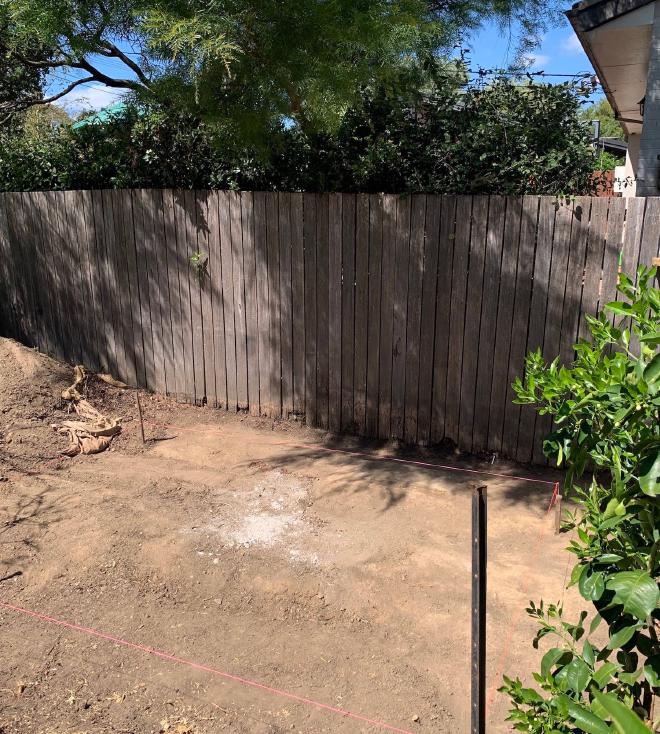
Hemp-lime walls readily absorb and release moisture so need some protection from rain. Best to have an eave of around 600mm. And I don’t want to block any of the neighbours’ sun, so the roof should not be much higher than the fence at the boundary. I decided on a single pitch roof coming down to the fence at around 20º. The internal wall height is 2300 mm on the high side and 1700 on the low side.

To support the large eaves, I decided to use 100x100mm timber beams, and these double as the top plates of my north and south walls.

I had salvaged some old hardwood framing from a house demolition in my street. Once planed back it looked brilliant. I wanted to showcase this timber by having it visible in the walls. Typically hemp-lime is cast around a central timber frame, fully encasing it. But it also works to have the structural timber frame on one side of the wall. In this case, the inside.
Hemp lime can be prefabricated into blocks or panels, but most commonly is cast in place using temporary formwork. I use plywood as the formwork.
Sketchup was useful to visualise and develop the design, and to plan the materials needed.

For a complete thermal envelope without breaks, I planned to continue the hemp-lime insulation from the walls into the roof. The roof structure is simple: just rafters sitting across the top plates of the north and south walls. But to fit enough hemp-lime in the roof for decent insulation performance, I needed rafters about 250mm deep. This is where I-joists are handy. They are as deep as you like, but only 10mm thick, so they are light and easy to handle, and the hemp insulation can be packed in, virtually eliminating thermal bridging.
A limecrete floor completes my limestone cave. (Hydrated lime — calcium hydroxide — slowly absorbs carbon dioxide from the air to turn back into limestone — calcium carbonate.)